i. Any warnings, precautions or measures to be taken by the patient with regard to reciprocal interference with reasonably foreseeable external influences, medical examinations or environmental conditions
Sinomed Neurovita gives comprehensive information on warnings, cautions and precautions for the user to ensure a safe and successful implantation of the Cometiu Stent.
In the following, only the patient-related warnings and precautions are listed:
Warnings
The Cometiu stent should be only used by medical doctors who have the required background knowledge and experience in the minimally invasive treatment of the brain using imaging techniques (interventional neuroradiology) and experience in using stent to expand narrowed arteries in the brain.
The Cometiu stent is delivered sterile and for one-time use only.
The application of the Cometiu stent may involve the risk of blood clotting (subacute thrombosis), vascular complications and/or bleeding.
The antiplatelet medication is also known as “blood thinners” in everyday language. Non-compliance to the antiplatelet medication can lead to occlusion of the arteries followed by stroke. A treatment with the Cometiu stent is always accompanied with the antiplatelet medications as they prevent from forming blood clots in the arteries. Blood clots can block the arteries and affect the blood supply leading to damage of the tissue supplied by that artery. If you have any questions regarding the agents, please consult your doctor.
Precautions
- After the stent is implanted, you will rest in a hospital unit where nurses and doctors can monitor you closely as you begin to recover.
- You may be asked to stay in bed for several hours and have some bruising and soreness at the area where the catheter was inserted, which is normal. If you received a sedative, you may feel sleepy or forgetful. Gradually, you will begin to feel normal. Pressure may be applied to the area of the incision to promote healing and prevent bleeding. It may be one or more days before you are discharged from the hospital.
- ·Follow the recommendations of your physician.
- ·Return to normal activities gradually and ask your doctor about specific exercise or strenuous activities.
- ·Let your doctor know about any changes in lifestyle you make during your recovery period.
- ·Keep up with all follow-up appointments, including any laboratory blood tests.
- ·Carry your Patient Implant Card at all times and show it to any medical professional who treats you, e.g. for dental work, medical care or when reporting to an emergency center.
- ·Register the stent and the conditions under which it can be scanned safely with the Medic Alert Foundation (www.medicalert. org) or equivalent organization.
ii.Expected lifetime of the device and any necessary follow up
- The lifetime of Cometiu stent is 10 years according to the performance Verification. After the stent is implanted, the stent remains permanently in the artery.
- Follow- Up Examinations: You will need to see the doctor who implanted your stent for routine follow-up examinations, including laboratory blood testing.
iii. Any other information to ensure safe use of the device by the patient
Medications
Follow your doctor’s instructions exactly regarding the use and dosage of medications prescribed. Report side effects from medications to your doctor immediately. These may include headaches, nausea, vomiting or rash.
Magnetic Resonance Imaging (MRI)
- If you require a magnetic resonance imaging (MRI) scan, tell your doctor or MRI technician that you have a Cometiu and present your patient implant card.
- In non-clinical testing, the Cometiu stent has been shown to be MR Conditional for single stents up to 40 mm in length. A patient with this device can be safely scanned in an MR system that meets the following conditions:
- ·Static magnetic field of 3.0T or less.
- ·Maximum spatial field gradient of 6.808 T/m or less.
- ·For radiofrequency heating of MRI, whole body averaged specific absorption rate (SAR) of ≤ 2.4 W/kg for 1.5 T and 3.0 T MRI system in 15 minutes, and the maximum temperature rise of a single stent did not exceed 1.5°C.The effect of MRl related heating for overlapping stents or stents with fractured struts is unknown.
- ·The static magnetic field conditions do not cause stent displacement.
- ·No results were shown in non-clinical tests to rule out the possibility of stent movement at static magnetic field strengths above 6.808T/m.
- ·Artifacts may have an effect if the imaging area is close to or at the stent implantation site.
Keep your ID Card Handy
Show your implant card if you report to an emergency room. This card identifies you as a patient who has had a stent implanted.
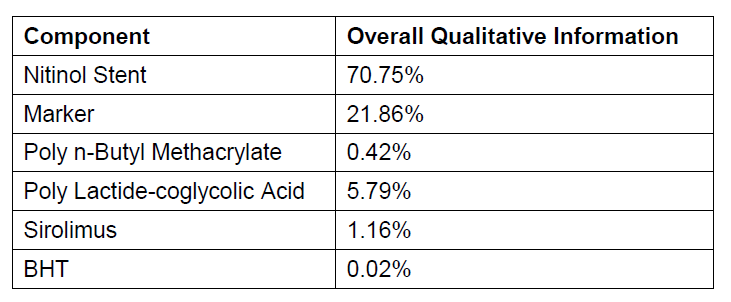
iv.Overall qualitative and quantitative information on the materials and substances to which patients can be exposed
Table 1 Qualitative and Quantitative Information on Implants